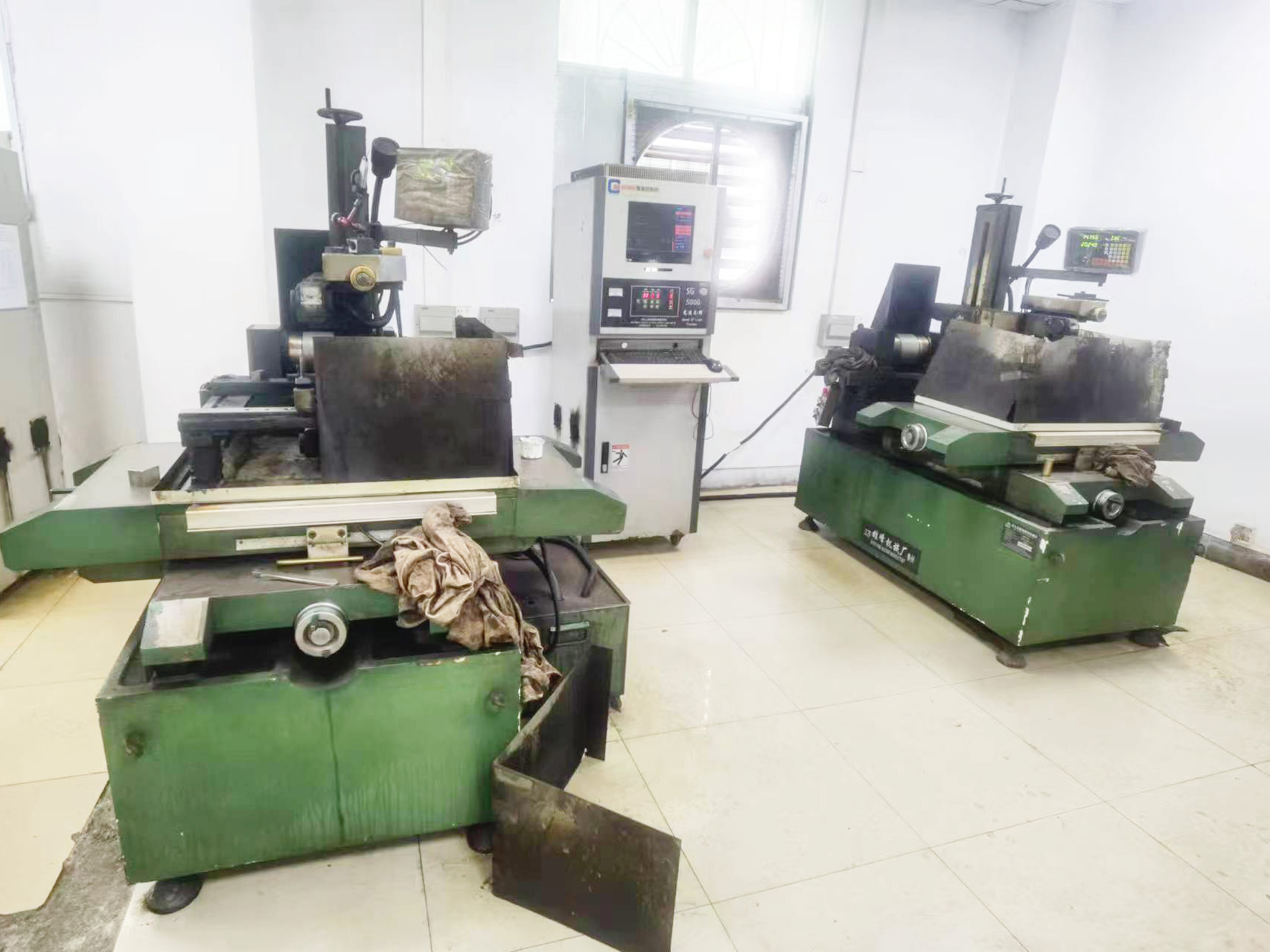
Utilizing 3-axis electrical discharge machining (EDM) for precision machining processes.
Utilizing 3-axis electrical discharge machining (EDM) for precision machining processes.
1) Special-shaped through-hole processing:
It can process various cross-section holes, small holes (φ0.01~3mm), etc., such as cold punching or punching dies, wire drawing dies and spinneret holes.
2) Cavity mold processing:
It is suitable for blind hole cavities and complex structures of forging dies, extrusion dies, die-casting dies, etc.
3) Wire cutting processing:
EDM wire cutting uses thin metal wires (such as molybdenum wires) as electrodes to perform pulse discharge to achieve electro-erosion processing of workpieces.
Features | CNC Turning Parts | |
Maximum Part Size | 236"x 118"x 24" (6,000 x 3,000 x 610 mm) | 62"Length x 32"Diameter (1,575 mm Length x 813 mm Diameter) |
Minimum Feature Size | 0.020″ (0.50 mm) | 0.020″ (0.50 mm) |
Estimated Delivery Time | 3-7 working days | 3-7 working days |
Standard Tolerance | ISO 2768 MK | ISO 2768 MK |
Precision Tolerance | ±0.0002"(±0.005mm) | ±0.0002"(±0.005mm) |
Threads and Threaded Hole | Standard threads and holes available, also customizable. | Standard threads and holes available, also customizable. |
Edge Conditions | Deburring by default. | Deburring by default. |
Surface Smooth | Ra 0.4 - 1.6μm | Ra 0.4 - 1.6μm |
Electrospark machining employs spark discharge to corrode metal materials, creating pits and irregular gaps. By connecting the workpiece and tool electrode to a pulse power supply, controlled by a servo system, this method generates local spark discharge that forms tiny pits on the workpiece's surface. Numerous electro-erosion pits overlap as the tool electrode advances, accurately replicating the tool shape for precision forming processes.
Process characteristics EDM has the following characteristics:
(1) Strong adaptability: EDM can process nearly all conductive materials and excels with high-strength, hard-to-cut materials and heat-resistant alloys.
(2) Complex part processing: EDM's non-rotating tool electrode enables the machining of intricate shapes like through holes and blind holes. Its minimal mechanical cutting force facilitates work on small, thin-walled, narrow grooves, cavities, and precision micro-processing.
(3) Adjustable pulse parameters: This single machine tool can handle rough, semi-finishing, and finishing operations. The dimensional accuracy post-processing varies based on the method used, achieving perforations as small as 0.05-0.1mm and cavities around 0.1mm.

 Applications EDM is widely used in:
Special-shaped through-hole processing: Capable of handling various cross-section holes, small apertures (φ0.01 to 3mm), such as in cold punching or punching dies, wire drawing dies, and spinneret holes.
Cavity mold processing: Ideal for intricate blind hole cavities and complex structures found in forging dies, extrusion dies, and die-casting dies.
Wire cutting processing: Utilizing thin metal wires like molybdenum as electrodes, EDM wire cutting facilitates electro-erosion processing of workpieces through pulse discharge.