


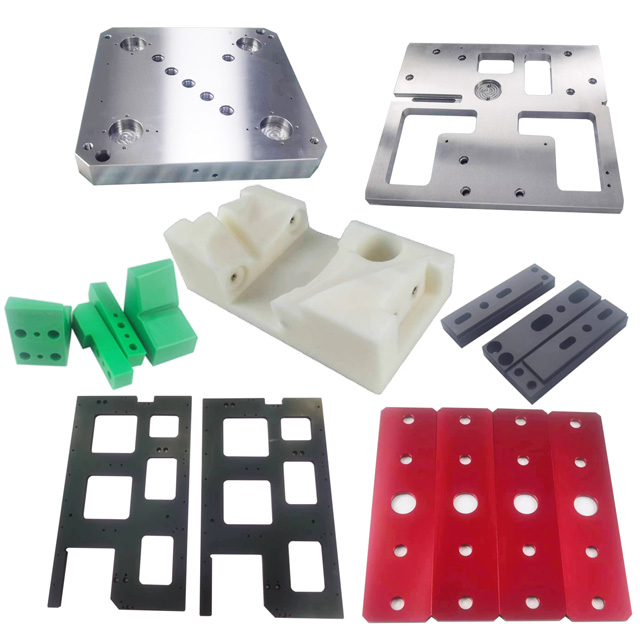
Delrin material CNC manufacturing services provided by precision machining manufacturers.
Hongsinn-304
Experience the precision of Delrin material CNC manufacturing services offered by our expert precision machining manufacturers. Elevate your projects with top-notch quality and accuracy. Contact us today for tailored solutions!
Delivery
FOB
minimum order
1 piece
Supply Ability
5000piece / Week
Country of Origin
Shenzhen
Stock Time
7~15Day
Quantity:
US $0.26 - US $3.98 / piece
Delrin material CNC manufacturing services provided by precision machining manufacturers.
Delrin material, CNC manufacturing, and machining manufacturers are essential components of modern industrial production. Delrin, a high-performance acetal resin, is known for its strength, durability, and low friction, making it ideal for precision components. CNC manufacturing leverages advanced technology to produce parts with exceptional accuracy and efficiency. This article explores the significance of Delrin material, CNC manufacturing, and the role of machining manufacturers in delivering high-quality solutions for diverse industries.
|
What is CNC machining?
CNC machining is a manufacturing process that uses computer-controlled tools and other machinery to create precise parts from raw materials. In CNC machining, a computer program is typically generated using computer-aided design (CAD) and computer-aided manufacturing (CAM) software, providing detailed instructions for the machining process.
These instructions include details such as tool paths, cutting speeds, and feed rates. CNC machines are able to interpret these instructions and perform machining operations with incredible precision and repeatability. This means that CNC machining not only improves production efficiency but also ensures the consistency and high quality of each part, and is widely used in various industries such as aerospace, automotive, medical, and electronics.
What does CNC stand for in manufacturing?
In manufacturing, CNC stands for Computer Numerical Control. This term describes a system where machining equipment, such as milling machines, lathes, routers, or grinders, is controlled by programmed computer commands rather than manual operation.
This automation not only improves machining accuracy and reduces human error but also significantly increases production efficiency, allowing equipment to operate continuously 24/7. Furthermore, many modern CNC systems integrate both additive and subtractive manufacturing techniques, allowing for multiple processing methods within a single machine, increasing flexibility and production capabilities. This integrated approach enables the manufacturing industry to respond quickly to market demands and drives continuous technological advancement.


CNC Machining Process Types
CNC machining encompasses various processes, such as milling, turning, drilling, and grinding, each suited to specific shapes and materials. These techniques can be used individually or in combination to manufacture complex part geometries with tight tolerances.
CNC Milling
This is the most common CNC process. In CNC milling, a rotating cutting tool moves along multiple axes to sculpt features, holes, and contours while the workpiece remains stationary. Multi-axis milling (from 3-axis to 5-axis) allows for the creation of highly detailed and multi-dimensional parts. Hongsinn's precision sheet metal forming is a good example of how CNC milling provides repeatable accuracy for commercial and defense applications.
This is the most common CNC process. In CNC milling, a rotating cutting tool moves along multiple axes to sculpt features, holes, and contours while the workpiece remains stationary. Multi-axis milling (from 3-axis to 5-axis) allows for the creation of highly detailed and multi-dimensional parts. Hongsinn's precision sheet metal forming is a good example of how CNC milling provides repeatable accuracy for commercial and defense applications.
CNC Turning
In turning operations, the workpiece rotates while a stationary cutting tool removes material. This process is ideal for creating cylindrical or circular parts, such as bushings, flanges, and shafts. CNC lathes are known for producing consistent, high-volume output with minimal variation.
In turning operations, the workpiece rotates while a stationary cutting tool removes material. This process is ideal for creating cylindrical or circular parts, such as bushings, flanges, and shafts. CNC lathes are known for producing consistent, high-volume output with minimal variation.
Drilling, Tapping, and Hybrid Machining
CNC machines can also perform secondary operations such as drilling, counterboring, and tapping. Hybrid CNC machines go a step further, performing two types of manufacturing processes in a single cycle, such as milling and 3D printing, or subtractive and additive manufacturing. This approach reduces setup time and improves efficiency.
CNC machines can also perform secondary operations such as drilling, counterboring, and tapping. Hybrid CNC machines go a step further, performing two types of manufacturing processes in a single cycle, such as milling and 3D printing, or subtractive and additive manufacturing. This approach reduces setup time and improves efficiency.
FAQ:


