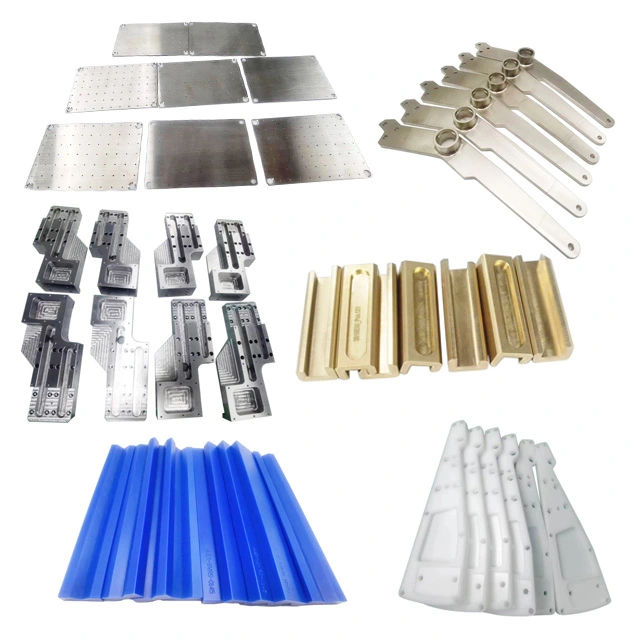
Turning and Milling Solutions for Precision Parts
Hongsinn-900
Our turning and milling services provide precision solutions for various materials, ensuring accuracy and reliability in every project.
Delivery
FOB
minimum order
1 piece
Supply Ability
5000piece / Week
Country of Origin
Shenzhen
Stock Time
7~15Day
Quantity:
US $0.59 - US $10.68 / piece
Our turning and milling services provide precision solutions for various materials, ensuring accuracy and reliability in every project.
The manufacturing landscape demands expertise across a wide spectrum of materials and processes, with brass milling, challenging milling titanium, and integrated turning and milling operations representing three critical yet distinct capabilities.
|
What is CNC milling?
CNC milling is an automated machining process used to manufacture 2D and 3D CNC parts by removing material from raw materials. Workshops use CNC milling machines to save time and increase productivity.
When manufacturing CNC milled parts, blocks or sheets of material are placed on a worktable under a spindle equipped with cutting tools. The computer is responsible for selecting the tool used, setting the spindle speed, and controlling the vertical movement of the spindle and the horizontal movement of the worktable. This automation allows for the loading of different tools, such as drills, taps, and end mills, to remove material and create the desired shape.
Overview of CNC Milling
CNC milling is a widely used manufacturing process capable of producing high-precision CNC parts. This production process relies on 3D CAD design, various tools, and machine shop equipment, such as heavy-duty drilling machines and CNC machine tools, to create customized 3D CAD models.
CNC machining can produce parts made of plastics, metals, and other materials, ensuring the highest tolerances and surface finishes. Furthermore, it is used for prototyping and production runs because it supports complex designs and can quickly meet precise specifications and tolerances.
This process is also suitable for manufacturing parts with specific surface treatments. It ensures that the machined parts have a uniform surface finish and meet stringent specifications and tolerance requirements.
The Difference Between CNC Milling and CNC Turning
Both CNC milling and turning can produce precise, custom-made parts from metals, plastics, and other materials. The main difference lies in the machining process: in milling, the cutting tool rotates, while in turning, the workpiece rotates. Therefore, turning is primarily used for machining custom-made round parts such as shafts, pins, and balls.
Another difference is that basic milling machines typically have three axes of motion, while lathes only require two. In milling, the cutting tool usually moves up and down, while the workpiece moves horizontally in two directions. In contrast, turning uses only a non-rotating cutting tool that moves left and right on one axis and back and forth on a second axis. In fact, the simplest form of turning has only two axes, which limits the diversity of shapes it can produce. For example, turning can create shapes such as shafts, chess pieces, and cylinders, but normal rotation cannot form simple boxes. However, advanced turning centers can have multiple axes, enabling the creation of a wider range of shapes.