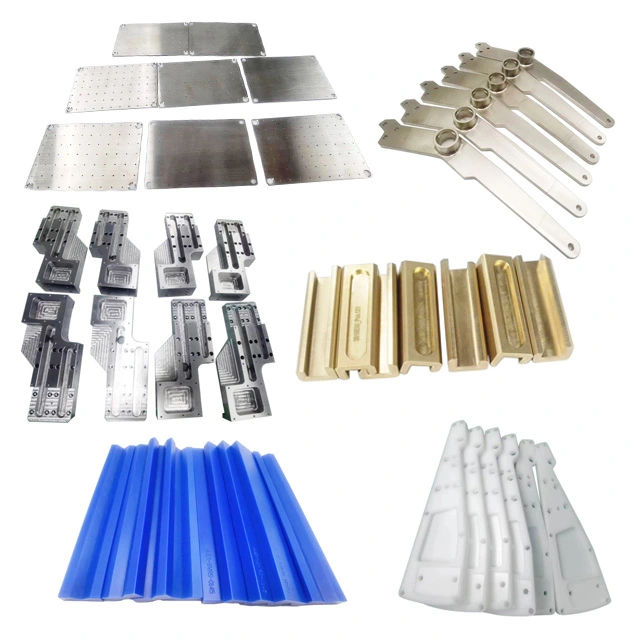
Small CNC Milling Solutions for Precision Parts
Hongsinn-901
Our small CNC milling solutions provide precision and efficiency, ideal for producing intricate components across various industries.
Delivery
FOB
minimum order
1 piece
Supply Ability
5000piece / Week
Country of Origin
Shenzhen
Stock Time
7~15Day
Quantity:
US $0.59 - US $10.68 / piece
Our small CNC milling solutions provide precision and efficiency, ideal for producing intricate components across various industries.
The landscape of CNC milling metals encompasses everything from industrial-scale CNC milling manufacturers to agile small CNC milling operations, creating a diverse ecosystem that serves everything from aerospace giants to prototype startups.
|
Why are CNC milling services important?
CNC milling services offer a highly efficient and effective manufacturing technology, enabling the precise production of custom-machined parts and products from plastics and metals to exact specifications and tolerances. For example, CNC milling processes can efficiently manufacture prototypes, automotive parts, or aerospace components while minimizing prototyping costs, saving time, reducing manual labor, and improving the overall manufacturing process.
The application of this technology is not limited to industrial fields; it is also widely used by hobbyists in woodworking, aluminum processing, prototyping, and more. The primary function of a CNC milling machine is to cut workpieces into desired shapes, and the complexity of the final workpiece can be significantly increased based on the number of axes of the CNC machine tool.
CNC milling can also handle a wide variety of materials, including aluminum, copper, steel, and various hard plastics, demonstrating its broad applicability and flexibility. This makes CNC milling services play a crucial role in modern manufacturing and design.
Considerations for Custom CNC Milling
Custom milling allows manufacturers to rapidly produce CNC prototypes and durable machined parts suitable for a variety of applications. When selecting CNC machining materials, it's important to note that only stainless steel is corrosion-resistant. If lightweighting is required, low-density metals such as aluminum, beryllium, titanium, and magnesium alloys should be considered. CNC milling machines are ideal for product development due to their ability to quickly and efficiently produce high-precision, high-resolution prototypes.
By creating a 3D model of the prototype using Computer-Aided Design (CAD) software, a CNC milling machine can generate a physical version of that prototype. This allows designers to create and test individual prototypes before mass production, facilitating the refinement and improvement of their designs. Furthermore, materials and alloys capable of withstanding high machining temperatures include titanium, stainless steel, nickel, and tantalum. Finally, material costs must be considered in custom CNC milling projects, as they directly impact the total cost.
Commonly Used Metals for CNC Milling
For custom milling projects, almost any sufficiently hard metal or plastic can be machined. In CNC machining workshops, the most commonly used material is aluminum alloy due to its natural corrosion resistance. Aluminum's strength and good machinability make it a popular choice for CNC milling prototypes, allowing for the accurate creation of complex features in a single prototype. 6000 series aluminum alloys are particularly common in milling workshops.
In addition, stainless steel alloys are also prevalent due to their corrosion and wear resistance. Other commonly used materials include carbon steel, titanium, and nylon, which are favored for their chemical resistance and durability.