CNC Production & Anodising Services for Precision Parts
Hongsinn-932
CNC production and anodising services offering custom, high-precision parts with durable finishes for aerospace and industry.
Delivery
FOB
minimum order
1 piece
Supply Ability
5000piece / Week
Country of Origin
Shenzhen
Stock Time
7~15Day
Quantity:
US $0.59 - US $10.68 / piece
CNC production and anodising services offering custom, high-precision parts with durable finishes for aerospace and industry.
|
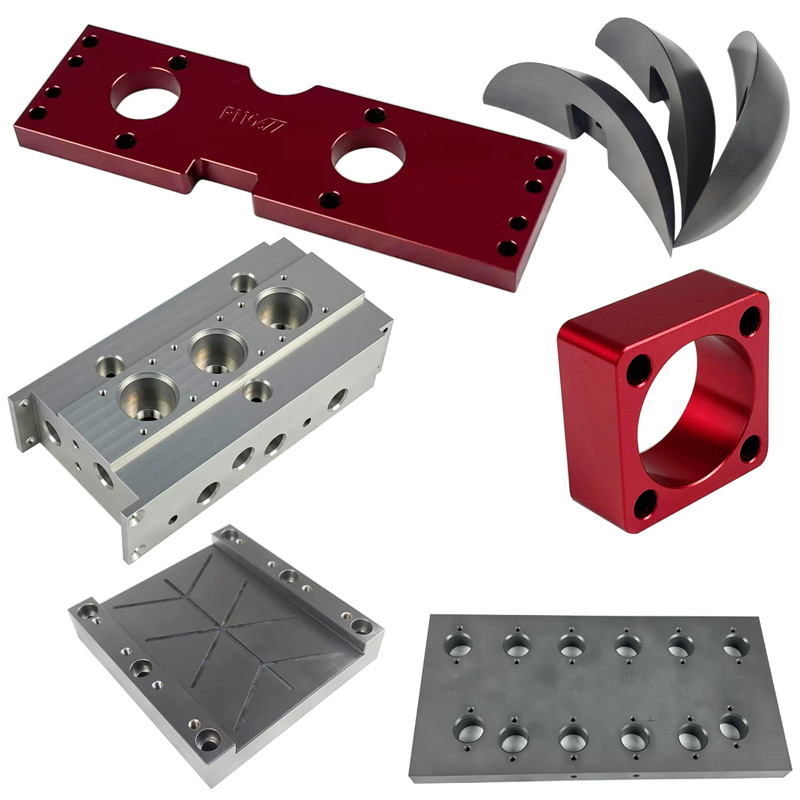

Anodizing Introduction and Applications
Anodizing is a common electrolytic passivation process primarily used to increase the thickness of the natural oxide layer on the surface of metal parts. Compared to bare or untreated metals, anodizing significantly improves the corrosion resistance and wear resistance of metals, while also enhancing the adhesion of primers and adhesives.
This process optimizes the microstructure of the metal surface by altering its crystal structure. Thicker anodized layers are typically porous, thus often requiring sealing treatment to further improve corrosion resistance. Compared to traditional paint or metal plating, anodized films are more robust and have stronger adhesion, making them less prone to cracking and peeling due to aging or wear, although they may be more susceptible to cracking under high thermal stress.
Furthermore, anodizing also has decorative functions:
It can form porous coatings that absorb various dyes to achieve multi-colored surfaces.
It can form thin, transparent films that produce reflective effects through light interference.
Anodizing is most commonly used for the protection of aluminum alloys, but there are also processes that can apply it to other metal materials, achieving a dual improvement in durability and aesthetics.
Anodizing type II
| Surface preparation | Colors | Glossiness | Cosmetic availability | Thickness** | Visual appearance |
|---|---|---|---|---|---|
| As machined (Ra 3.2μm / Ra 126μin) | Clear, Black, Red, Blue, Orange, Gold | Glossy (Equal or above 10 GU) | No | for clear: minimum average thickness 10μm, minimum local thickness 8μm;black and color: minimum average thickness 15μm, minimum local thickness 12μm | Parts are anodized directly after machining. Machining marks will be visible. |
| Bead blasted | Clear, Black, Red, Blue, Orange, Gold | Matte (2-10 GU) | Cosmetic on request | Same as above | Grainy texture, matte finish |
| Bead blasted | Clear, Black, Red, Blue, Orange, Gold | Glossy (Equal or above 5 GU) | Cosmetic on request | Same as above | Grainy texture, glossy finish |
| Brushing(Ra 1.2μm / Ra 47μin) | Clear, Black, Red, Blue, Orange, Gold | Glossy (Equal or above 10 GU) | Cosmetic on request | Same as above | Parts are manually brushed to reduce marks, then anodized. Brushing lines will be visible. |
Anodizing type III
| Surface preparation | Colors | Cosmetic availability | Thickness | Visual appearance |
|---|---|---|---|---|
| As machined (Ra 3.2μm / Ra 126μin) | Black, Natural (thicker layers will appear darker) | No | 35 to 50μm(0.0013” to 0.0019”) | Parts are anodized directly after machining. Machining marks will be visible. |
| Bead blasted (Glass beads #120) | Black, Natural (thicker layers will appear darker) | Cosmetic on request | 35 to 50μm(0.0013” to 0.0019”) | Can be slightly visible if parts are “Not Cosmetic” Completely removed if parts are “Cosmetic” |
Our Anodizing Process
Hongsinn's anodizing process not only protects aluminum parts from wear and corrosion but also enhances their aesthetics. Here are the key steps of our standard anodizing process:
**Connecting Parts to the Anode**
The aluminum part is secured and connected to the anode terminal, ready for electrolytic treatment.
The aluminum part is secured and connected to the anode terminal, ready for electrolytic treatment.
**Immersion in Acidic Electrolyte**
The part is placed in a specific acidic solution to create an environment conducive to the electrochemical reaction.
The part is placed in a specific acidic solution to create an environment conducive to the electrochemical reaction.
**Connecting the Cathode to the Metal Electrode**
The cathode is placed in the solution, forming a complete current loop.
The cathode is placed in the solution, forming a complete current loop.
**Forming a Porous Oxide Layer**
Positive ions react with negative oxygen ions to form a uniform porous alumina layer on the part surface.
Positive ions react with negative oxygen ions to form a uniform porous alumina layer on the part surface.
**Coloring and Decorative Treatment**
Corrosion inhibitors or dyes can be used as needed to achieve both protection and aesthetics.
Corrosion inhibitors or dyes can be used as needed to achieve both protection and aesthetics.
**Sealing the Nanopores**
The porous structure is sealed to improve corrosion resistance and stabilize color, optimizing both performance and appearance.
The porous structure is sealed to improve corrosion resistance and stabilize color, optimizing both performance and appearance.
This process ensures that aluminum parts are both durable and aesthetically pleasing, suitable for a wide range of applications including aerospace, automotive, electronics, and industrial manufacturing.