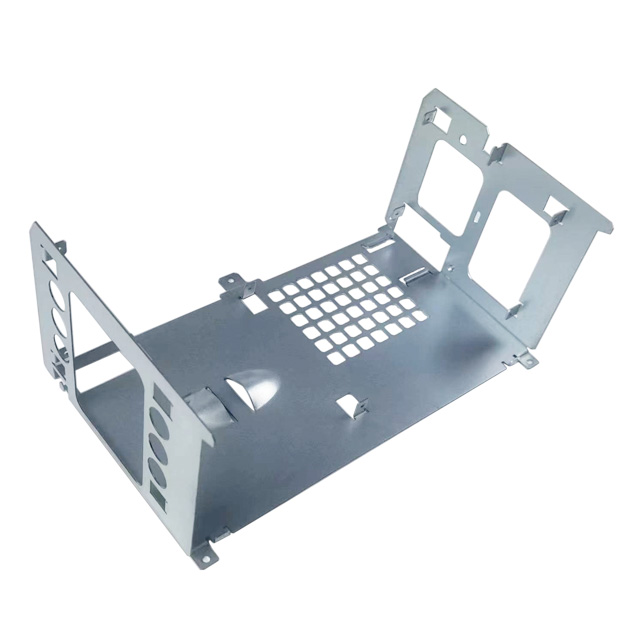
Explore sheet metal manufacturing, machining processes, and hemming techniques.
Explore sheet metal manufacturing, machining processes, and hemming techniques.
Custom Precision Sheet Metal Fabrication Parts | ||||
Quotation | According to your drawing(size, material, thickness, processing content, and required technology, etc) | |||
Material | Carbon steel, stainless steel,SPCc, SGCc, pipe, galvanized | |||
Processing | Laser cutting, bending, riveting, drilling, welding, sheet metal forming, assembly, etc. | |||
Surface Treatment | Brushing, Polishing, Anodizing, Powder Coating, Plating, | |||
Tolerance | '+/-0.2mm, 100% QC quality inspection before delivery, can provide quality inspection form | |||
Logo | Silk print, Laser marking | |||
Size/Color | Accepts custom sizes/colors | |||
Drawing Format | .DWG/.DXF/.STEP/.IGS/.3DS/.STL/.SKP/.AI/.PDF/.JPG/.Draft | |||
Sample Ead Time | Negotiate delivery time according to your needs | |||
Packing | By carton/crate or as per your requirement | |||
Certificate | ISO9001:SGS/TUV/ROHS | |||
1. CNC Machining:
Computer Numerical Control (CNC) machining is widely used in sheet metal fabrication for its precision and efficiency. CNC machines are programmed to perform various machining operations such as cutting, drilling, and milling with high accuracy.
2. Laser Cutting:
Laser cutting is a popular sheet metal machining process that uses a high-powered laser beam to cut through the material. This technique is known for its speed, precision, and ability to produce intricate shapes with smooth edges.
3. Punching:
Punching is a process that involves using a punch and die to create holes or other features in sheet metal. This method is commonly used for producing components with repeated patterns or shapes.
4. Bending:
Bending is a forming process that involves deforming the sheet metal to create angles, curves, or shapes. Press brakes are often used to bend sheet metal accurately to the desired specifications.
5. Blanking:
Blanking is a shearing process that involves cutting a flat shape from a sheet of metal. This technique is used to create components with precise dimensions and smooth edges.
6. Grinding and Finishing:
Grinding and finishing processes are essential for improving the surface quality of machined sheet metal components. These processes help remove imperfections and ensure the parts meet the required specifications.
7. Quality Control:
Quality control is a critical aspect of sheet metal machining processes. Inspecting the machined components for dimensional accuracy, surface finish, and integrity ensures that they meet the desired quality standards.